
RocketAiFlow is built for companies and integrators that need to run Voice AI workflows while controlling the outbound dialer, telephony, data, business APIs, outcomes, and operational monitoring.

RocketAiFlow helps teams run AI voice workflows across inbound routing, outbound campaigns, API-connected actions, and post-call review without losing operational control.
Route repetitive inbound calls to AI agents for triage, qualification, intake, overflow, or first-line handling.
Run outbound lists with controlled call rhythm, concurrency limits, retries, callback scheduling, contact priority, outcomes, and call records.
Let agents read or update CRM, calendar, helpdesk, ERP, webhooks, database data through a backend, internal APIs for company systems, or external APIs for SaaS/provider workflows.
Escalate sensitive or unresolved calls to a person while preserving the context collected by the AI agent.
Start with one concrete workflow, connect telephony and business systems, define the agent behavior, then monitor outcomes before scaling.
Start from one measurable inbound route, outbound campaign, callback flow, or API-driven action.
Map telephony, providers, agent behavior, business APIs, custom fields, and handoff rules.
Set call rhythm, concurrency, retries, callback rules, data scope, outcome tracking, and escalation conditions.
Review live metrics, call records, transcripts, optional recordings, logs, traces, and operational outcomes.
RocketAiFlow is not positioned as a generic hosted voice bot. It is an operating layer for companies and integrators that need control across dialer execution, telephony, AI behavior, business APIs, and monitoring.
Work with SIP/PBX and Asterisk-based paths validated during setup.
Choose speech, voice, LLM, and telephony providers around the workflow requirements.
Control outbound volume, retries, callbacks, contact priority, and campaign outcomes before scaling.
Trigger business actions during or after calls through configured API functions.
Keep live metrics, call records, logs, traces, and post-call review close to the workflow.
The strongest fit is with companies that manage repeatable phone volume, connected systems, and measurable operational outcomes.
Manage overflow, first-line handling, outbound campaigns, and follow-up without scaling operators linearly.
Qualify leads, book demos, follow up contacts, and keep CRM or calendar systems aligned.
Automate reminders, status checks, intake, callback scheduling, and repeat service requests.
The goal is not to replace every conversation. It is to move repetitive, structured phone work to AI agents while keeping humans focused on complex or high-value cases.
Move repetitive inbound, outbound, reminder, and follow-up work away from manual operations.
Capture outcomes, call records, transcripts, optional recordings, API results, and timing details.
Set rhythm, active-call limits, retry logic, callback behavior, provider choices, and workflow boundaries before scale.
Expand volume only after the first validated workflow proves technical and business fit.
Short answers on pilot setup, telephony fit, provider flexibility, monitoring, API actions, and human handoff.
RocketAiFlow is in early access: we are selecting pilot partners to validate AI outbound campaigns, repetitive inbound, automatic callbacks, precise call scheduling, contact priority, transcripts, recordings, and live monitoring on real workflows.
Yes. Operational demos are run on request in a controlled environment so we can show RocketAiFlow on a realistic workflow: contact list, campaign configuration, automatic callbacks, minute-level scheduling, live monitoring, call data, transcripts, recordings when enabled, and API integrations.
At this stage RocketAiFlow is available through guided pilots with pricing on request. The proposal depends on the workflow to validate, call volume, integrations, data to save, transcript or recording options, and the technical environment agreed with the customer. The model may include pilot setup, platform fee, and variable consumption.
RocketAiFlow is designed to validate real phone workflows with pilot partners: AI outbound campaigns, appointment setting, lead qualification, reminders, follow-up, surveys, unreached-contact recovery, inbound overflow, routing, data collection, and first-line support.
RocketAiFlow is outbound-first and inbound-ready. The outbound module supports campaign management, intelligent call rhythm, scheduling, automatic callbacks, contact priority, and live monitoring. The inbound module lets teams handle incoming calls with AI agents, simultaneous conversation limits, saved call data, transcripts, and recordings when enabled.
You can configure campaign duration, active days, time windows, time zone, maximum callback attempts, rules after no answer, list upload, exact date, hour, and minute for each contact, contact priority, intelligent call rhythm, and campaign operating limits.
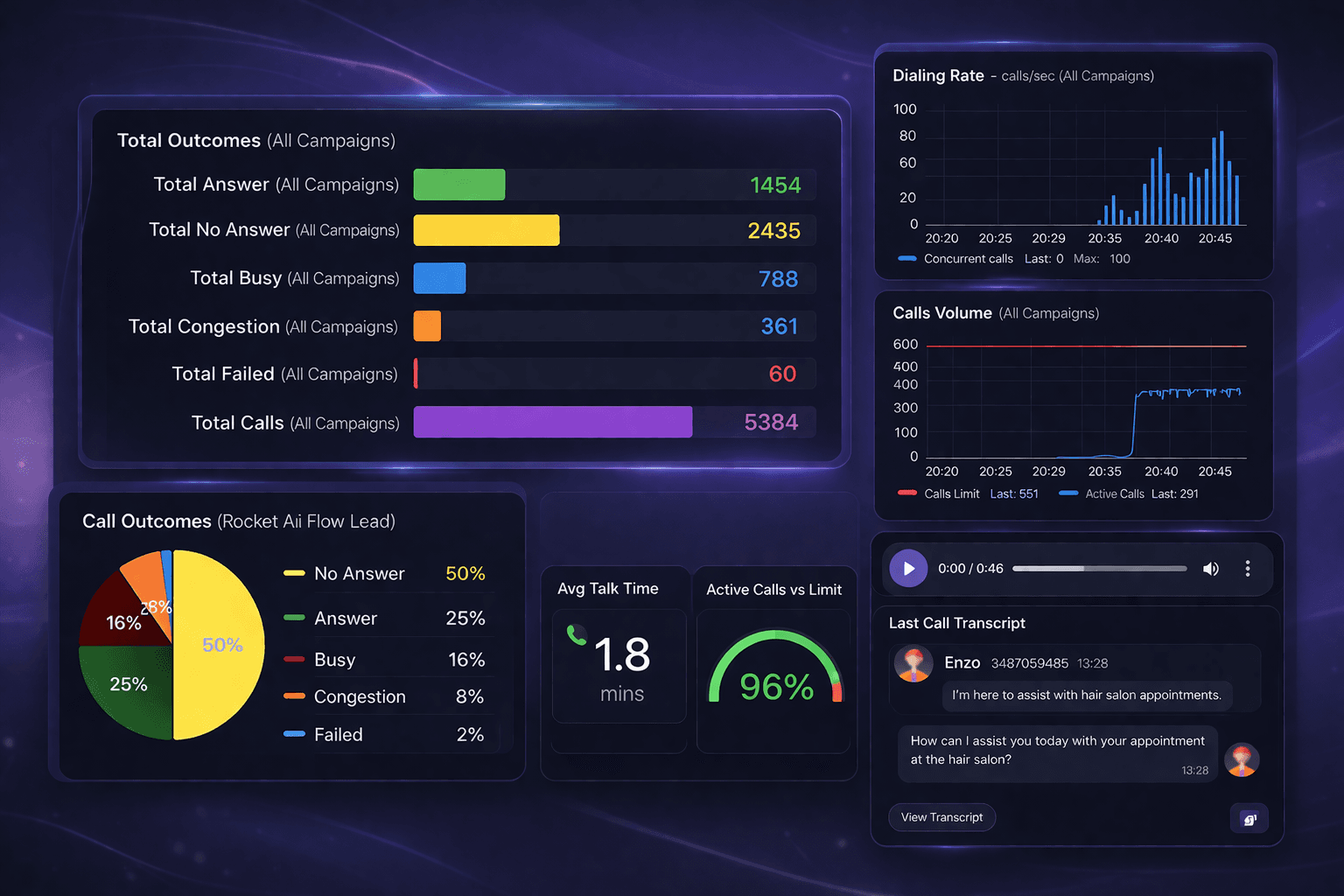
While the campaign is running, you can monitor active calls, outcomes, answered calls, no answers, busy calls, failures, call rhythm trends, saturation, performance, and history. The team sees what is happening while the campaign is live, not only at the end of the day.
Yes. In internal tests with real phone traffic in a controlled environment, RocketAiFlow handled up to 300 simultaneous calls, with startup peaks of up to 100 call attempts per second and list loading up to 1 million contacts on an 8 GB RAM machine. These tests validate the technical base for high-volume outbound scenarios. Actual production performance depends on infrastructure, telephony, providers, configuration, recordings, transcripts, connected APIs, and campaign duration.
Review your first inbound or outbound workflow, telephony path, API functions, provider stack, monitoring needs, and pilot scope.